

The next major version of Vanilo is 6.0, and it has been released on September 25th, 2026.
This release brings several features and improvements, including non-product line items, Laravel 13 support, taxon improvements, and EU Order Withdrawal support.
Additionally, it includes a variety of enhancements and bug fixes.
Until now, Vanilo segregated products into cart/order items while relegating secondary charges—such as shipping fees, handling surcharges, gift wrapping, or specialized service fees—to order-level adjustments.
While adjustments work for many cases, it has several limitations. The most important one is that Vanilo's Tax module can't calculate taxes on adjustments, only for line items.
Additionally, certain businesses treat certain non-product items as true billable items, which can't be represented as adjustments. This may cause friction across integrations: ERPs, fulfillment systems, and third-party tax engines that require line-level taxation.
Starting with Vanilo v6.0, the framework introduces first-class architectural support for Non-product Line Items.
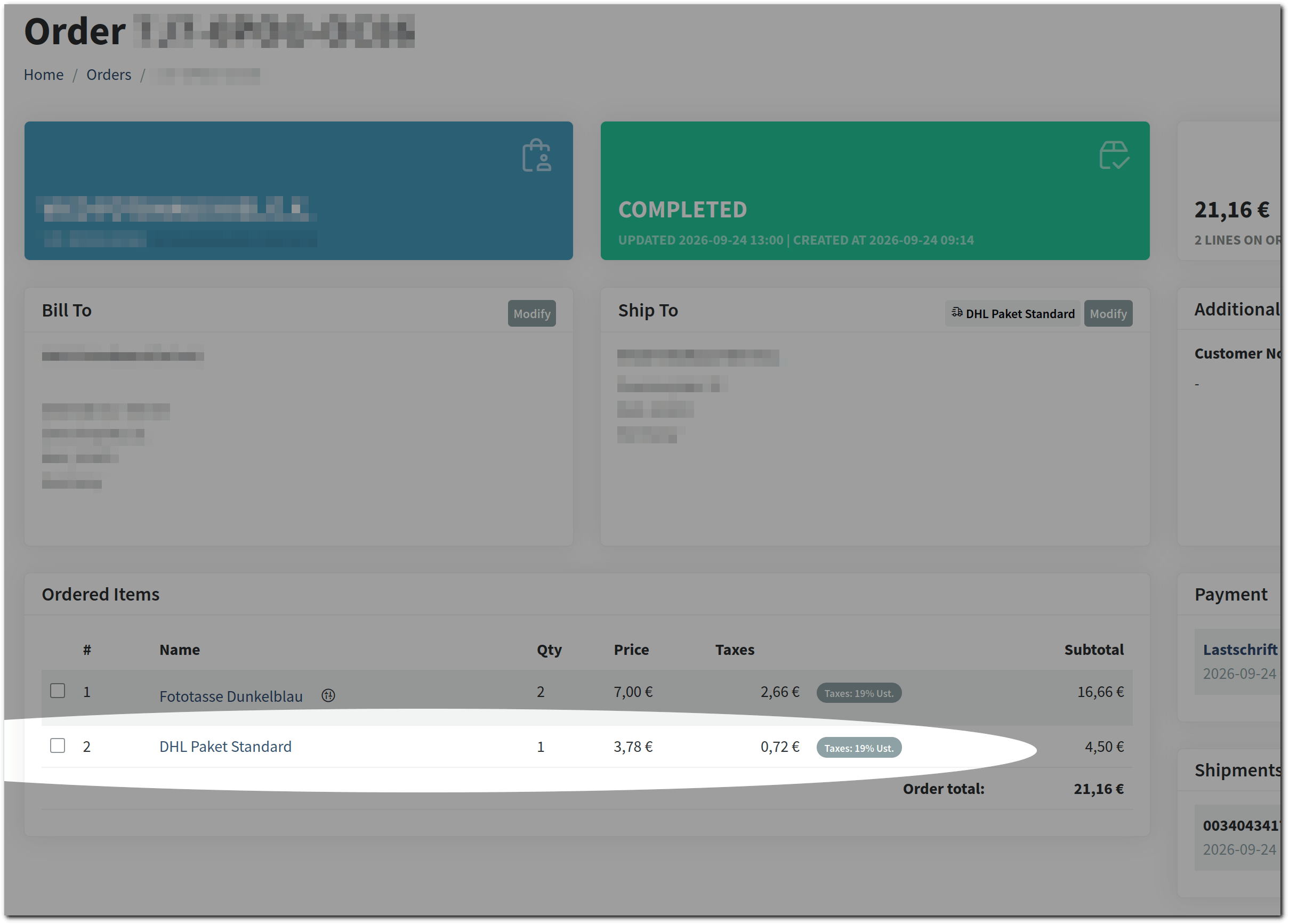
By enabling non-product entities to act as buyable line items, systems achieve maximum data fidelity, eliminate conversion overhead between cart and ERP payloads, and unlock granular per-item tax classification.
The following interfaces were introduced: LineItem, LineItemType, and the LineItemTypes registry.
The LineItem interface defines the characteristics of any item in a cart or order:
namespace Vanilo\Contracts;

interface LineItem
{
    public function getName(): string;

    public function getQuantity(): int|float;

    public function isShippable(): bool;

    public function isPhysical(): bool;

    public function isService(): bool;

    public function isDigital(): bool;
}
This interface enables a flexible evaluation logic of a given item generically without type-casting or model probing.
The LineItemType interface and LineItemTypes registry
namespace Vanilo\Contracts;

use Konekt\Extend\Contracts\Registerable;

interface LineItemType extends Registerable
{
    public function hasPrice(): bool;
}
Plugins and app can register new line item types through the Vanilo\Support\LineItemTypes registry:
use Vanilo\Support\LineItemTypes;

// Registering a custom service fee line item type
LineItemTypes::register('installation_service', InstallationServiceType::class);

// Instantiating via the registry
$lineItemType = LineItemTypes::make('installation_service');
Vanilo 6.0 adds a single additional line item type, and that is the shipping method.
The Vanilo\Foundation\Models\ShippingMethod class now implements both the Buyable and Taxable interfaces, which
allows:
tax_category_id, enabling shipping fee taxationmorphTypeName() returning 'shipping_method', shipping records seamlessly persist into order_items tables with product_type = 'shipping_method' and product_id = shipping_method.id.usage_count and last_usage_at timestamps automatically upon order completion.The line-item-based shipping approach is available via an opt-in configuration flag, preserving backwards compatibility for adjustment-based architectures.
1. Enabling the Feature Flag
Enable shipping line items in your config/vanilo.php configuration:
// config/vanilo.php
'foundation' => [
    'use_shipping_lines' => true,
    // ...
],
2. Automated Fee Calculation Pipeline
When foundation.use_shipping_lines is enabled, the CalculateShippingFees listener intercepts cart and checkout events,
purges obsolete shipping line items, calculates the rate via the configured ShippingMethodCalculator, and inserts the
shipping charge as a distinct cart item.
3. Unified Aggregation on Orders
The Order model computes shippingTotal across both paradigms seamlessly, summing line-item-based shipping entries
along with any adjustment-based shipping items:
// In Vanilo\Foundation\Models\Order
$order->shipping_total; // Automatically includes line items where product_type = 'shipping_method'
LineItem and LineItemType registry system provides a clean extension point for custom charges such as hazardous material fees, recycling surcharges, or extended warranty packages.Shipping methods now feature built-in usage tracking with the addition of usage_count and last_usage_at attributes. This enables analytics, usage limits, and popularity metrics for shipping options directly on the ShippingMethod Eloquent model.
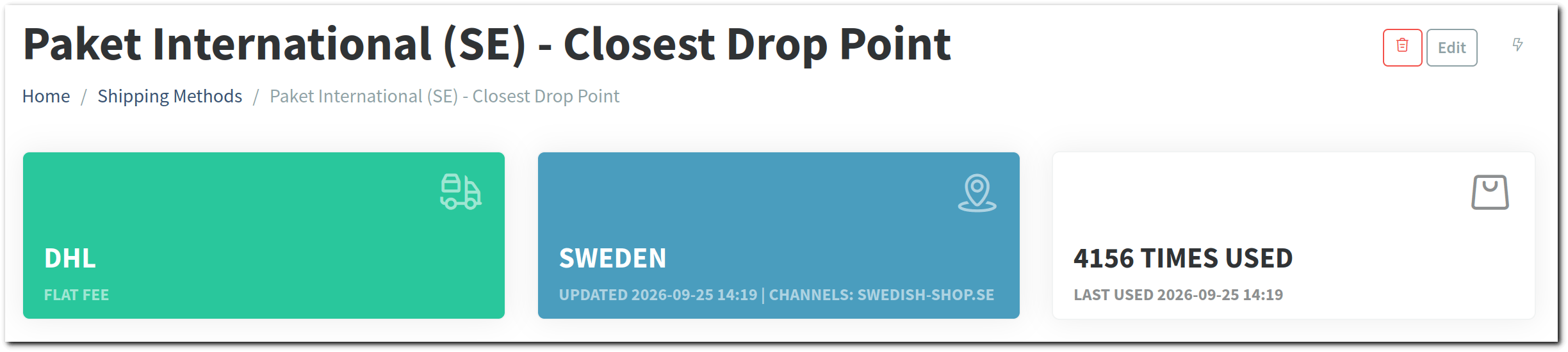
The shipping_methods table and models have been extended with two new fields:
usage_count (int, default 0): Tracks the total number of times the shipping method has been used in completed orders.last_usage_at (Carbon|null, nullable datetime): Stores the timestamp of the most recent order placed using this shipping method.In the Foundation module, the Vanilo\Foundation\Models\ShippingMethod model implements the Buyable interface and provides the addSale(Carbon $date, int|float $units = 1) and removeSale(int|float $units = 1) methods to mutate these stats.
The usage counter and last used timestamp are updated automatically via domain event handling upon order placement:
OrderWasCreated event is dispatched.UpdateSalesFigures listener handles the event and processes sales figure updates, resolving the sale date from $order->ordered_at ?? $order->created_at.try...catch block, ensuring that any statistical calculation anomaly is logged without disrupting the order processing pipeline.The listener automatically detects and adapts to the active shipping fee architecture:
foundation.use_shipping_lines)When shipping fees are modeled as order line items:
UpdateSalesFigures detects the shipping line item during line iteration.$item->product->addSale($saleDate, $item->quantity).$item->product->removeSale() balances the count.When using the default adjustment-based mode without dedicated shipping order lines:
$order->shipping_method_id and loads the associated $order->shippingMethod relation.Buyable (such as Foundation's ShippingMethod), it triggers $shippingMethod->addSale($saleDate).ShippingMethod models without Buyable, it performs a direct model update:$shippingMethod->update([
'usage_count' => $shippingMethod->usage_count + 1,
'last_usage_at' => $saleDate,
]);
Calculating prices, discounts, and taxes in e-commerce often demands precise control over rounding behavior. Depending on regional accounting standards or store configurations, rounding might need to occur at standard currency precision (2 decimals), extended micro-precision (e.g., 4 or 6 decimals to prevent cumulative rounding discrepancies in line items), or differ between individual items and aggregate totals.
To centralize and customize precision rules across the framework, Vanilo introduces the static Vanilo\Support\Rounding service.
Rounding Class WorksRounding is an in-memory singleton configuration registry and rounding utility. It determines decimal precision based on two dimensions:
RoundingTarget:
adjustment - which applies to adjustments (discounts, taxes, shipping fees, etc.).* (anything else, at the moment)RoundingLevel:
line - Precision applied at line-item level.aggregate — Precision applied to aggregated totals.* - Wildcard level applying to any other scope.You can configure precision rules during application boot (e.g., in a service provider) using setRoundingRuleFor():
use Vanilo\Support\Models\RoundingLevel;
use Vanilo\Support\Models\RoundingTarget;
use Vanilo\Support\Rounding;

// Set 4-decimal precision for all adjustment calculations
Rounding::setRoundingRuleFor(RoundingTarget::Adjustment, RoundingLevel::Any, 4);

// Set 4-decimal precision specifically for line items, keeping 2 decimals for aggregates
Rounding::setRoundingRuleFor(RoundingTarget::Adjustment, RoundingLevel::Line, 4);
Rounding::setRoundingRuleFor(RoundingTarget::Adjustment, RoundingLevel::Aggregate, 2);

// Direct calculation helper
$rounded = Rounding::roundAdjustment(14.52987, RoundingLevel::Line); // 14.5299
RoundingSeveral core modules in the framework leverage the Rounding service:
RoundsAdjustments TraitAdjusters use this trait to easily round adjustment values according to the active Rounding ruleset.
It exposes the following helper methods:
round(float $value, RoundingLevel $level = RoundingLevel::Any, ?AdjustmentType $type = null): floatroundTax(float $value, RoundingLevel $level = RoundingLevel::Any): floatroundPromotion(float $value, RoundingLevel $level = RoundingLevel::Any): floatPercentDiscount: Calculates promotion adjustments and rounds the resulting deduction using roundPromotion().SimpleTax: Calculates tax adjustment amounts and rounds using roundTax().SimpleTaxDeduction: Calculates tax deduction amounts and rounds using roundTax().Tax calculators (such as DefaultTaxCalculator and DeductiveTaxCalculator) rely on the tax adjusters,
inheriting the precision configured in Rounding for tax amounts.
Rounding in Custom AdjustersYou can use the RoundsAdjustments trait in custom adjusters to respect system-wide rounding rules:
namespace App\Adjusters;

use Vanilo\Adjustments\Contracts\Adjustable;
use Vanilo\Adjustments\Contracts\Adjuster;
use Vanilo\Adjustments\Contracts\Adjustment;
use Vanilo\Adjustments\Support\RoundsAdjustments;
use Vanilo\Support\Models\RoundingLevel;

final class CustomFeeAdjuster implements Adjuster
{
    use RoundsAdjustments;

    public function calculateAmount(Adjustable $adjustable): float
    {
        $rawAmount = $adjustable->preAdjustmentTotal() * 0.035;

        // Automatically applies RoundingTarget::Adjustment rule
        return $this->round($rawAmount, RoundingLevel::Line);
    }
}
The Category module received several enhancements to improve tree navigation, status control, and model-level taxon retrieval.
The Taxon model now has an is_active boolean field (defaults to true). This allows disabling individual taxons (categories) without deleting records or breaking historical references.
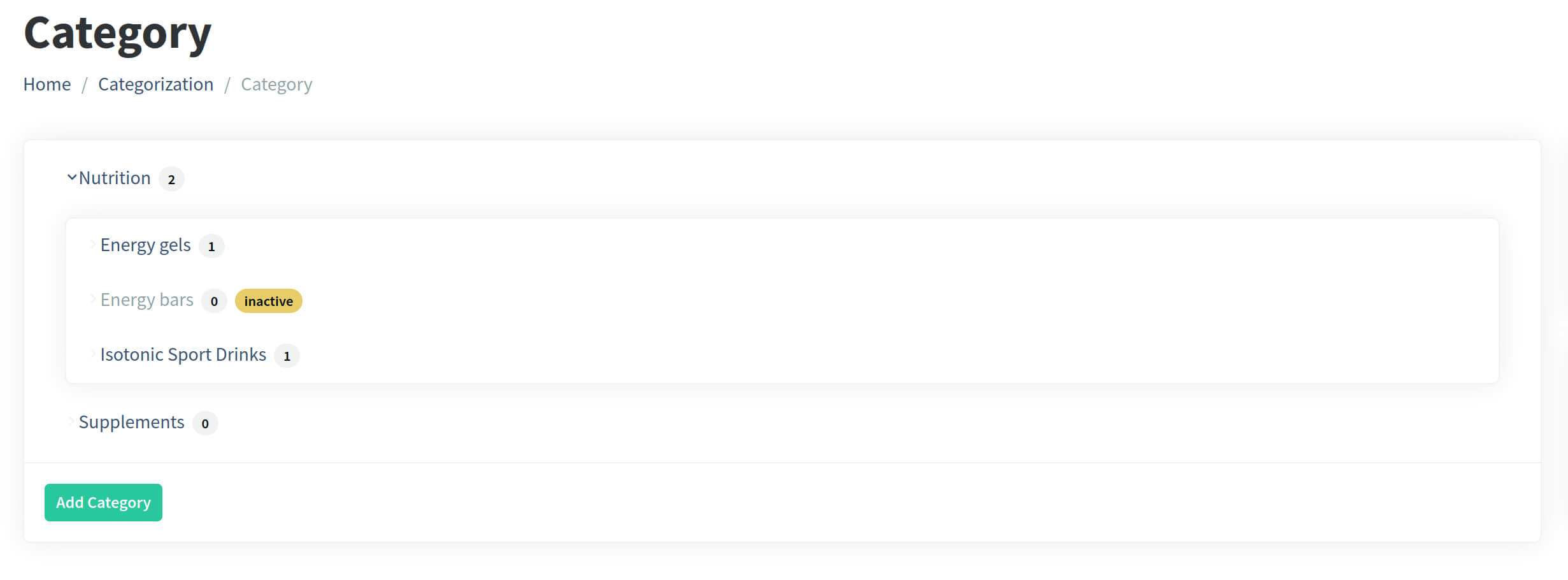
Two query scopes have been introduced to streamline filtering:
Taxon::activeOnes(): scopes the query to active recordsTaxon::inactives(): scopes the query to inactive recordsTaxonomy::activeRootLevelTaxons()The Taxonomy model has the rootLevelTaxons() method for years, which returns all the root level taxons, regardless
of the active/inactive state.
Vanilo 6 introduces the activeRootLevelTaxons(): Collection method, which als queries only top-level taxons, that are active, automatically sorted by priority.
$categories = Taxonomy::findOneBySlug('categories');
$rootTaxons = $categories->activeRootLevelTaxons();
Taxon::activeChildren RelationshipThe $taxon->children relationship returns all the children of a given taxon, regardless of the active/inactive state.
Vanilo 6 comes with the Taxon::activeChildren(): HasMany relationship.
It loads only active immediate children (parent_id = $taxon->id where is_active = true), ordered by priority.
This eliminates manual filtering when traversing category trees for navigation menus and sidebars.
foreach ($taxon->activeChildren as $child) {
    // only active child taxons ordered by priority
}
taxonsIn() and firstTaxonIn() on HasTaxonsModels using the HasTaxons trait (such as Product or MasterProduct) now provide convenient helper methods to
retrieve assigned taxons for a specific taxonomy:
taxonsIn(string|Taxonomy $taxonomy, bool $withInactive = false): Collection: returns all assigned taxons within the specified taxonomy (passed as a Taxonomy instance or slug). By default, only active taxons are returned.firstTaxonIn(string|Taxonomy $taxonomy, bool $withInactive = false): ?Taxon: returns the first assigned taxon in the specified taxonomy, filtering out inactive ones unless explicitly requested.// Retrieve the primary brand or category
$brand = $product->firstTaxonIn('brands');
// Retrieve all active categories assigned to the product
$productCategories = $product->taxonsIn('categories');
// Include inactive taxons if needed
$allTaxons = $product->taxonsIn('categories', withInactive: true);
The taxon retrieval methods that existed up until Vanilo 5.2 still return both active and inactive taxons.
In order to filter out the inactive entries (typically needed for the frontend), you need to use the new
activeRootLevelTaxons() and activeChildren accessors.
Below is a simplified Blade snippet showing how to render a multi-level navigation menu that hides inactive taxons:
<ul>
    @foreach($categories->activeRootLevelTaxons() as $category)
        <li>
            <a href="{{ url_of($category) }}">{{ $category->name }}</a>

            @if($category->activeChildren->isNotEmpty())
                <ul>
                    @foreach($category->activeChildren as $subCategory)
                        <li>
                            <a href="{{ url_of($subCategory) }}">{{ $subCategory->name }}</a>

                            @if($subCategory->activeChildren->isNotEmpty())
                                <ul>
                                    @foreach($subCategory->activeChildren as $leaf)
                                        <li>
                                            <a href="{{ url_of($leaf) }}">{{ $leaf->name }}</a>
                                        </li>
                                    @endforeach
                                </ul>
                            @endif
                        </li>
                    @endforeach
                </ul>
            @endif
        </li>
    @endforeach
</ul>
The properties table now has two new optional text fields: excerpt and description.
excerpt: Intended for short summaries, helper hints, or UI tooltips (e.g., explaining abbreviated or cryptic attribute codes such as what "H135" means for an ice cream vitrine).description: Supports longer, detailed content such as sizing charts, measurement specifications, rich markdown/HTML guides, or comprehensive property documentation.Previously, Property definitions were limited to their identifying name, slug, type, and configuration payload,
requiring developers to store descriptive UI metadata or attribute explanations elsewhere
(such as within unstructured configuration JSON payloads or custom schema extensions).
With first-class excerpt and description attributes:
Under European Union consumer protection directives, consumers shopping online have a statutory cooling-off period of at least 14 calendar days to withdraw from distance purchase contracts without providing justification.
To support compliance and domain separation between regular merchant/system cancellations and customer-initiated revocations, Vanilo now provides first-class support for order withdrawals along with dedicated lifecycle events.
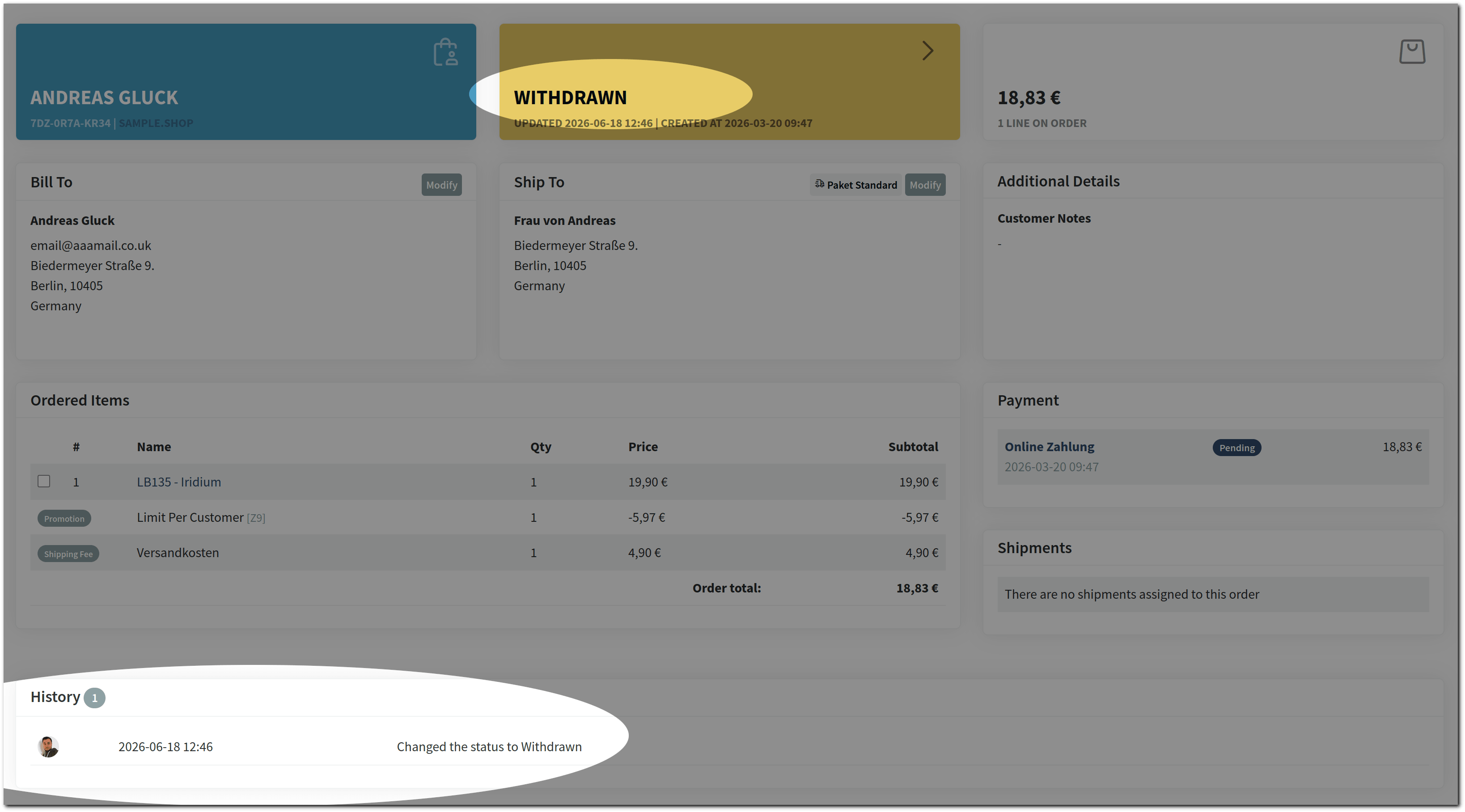
The OrderStatus enum now includes the withdrawn state (OrderStatus::WITHDRAWN).
Developers can utilize both property-based and method-based enum helpers:
$order->status->is_withdrawn$order->status->isWithdrawn()OrderStatus::WITHDRAWN()The OrderWasWithdrawn & OrderStateChangedToPending domain events.
To enable reactive workflows in event-driven architectures (such as triggering automated refund pipelines,
ERP stock releases, return shipping label creation, or audit logs), two new domain events were introduced in Vanilo\Order\Events:
OrderWasWithdrawn: Dispatched when an order transitions into the withdrawn state by a customer exercising their statutory right of withdrawal.OrderStateChangedToPending: Dispatched when an order state is set or reverted back to pending.With the enum helper properties and date calculations, exposing an EU-compliant self-service order withdrawal action in the customer portal / account dashboard requires just a few lines in your Blade template:
@if(!$order->status->is_withdrawn && $order->ordered_at->diffInDays() < 14)
    {!! Form::model($order, ['route' => ['shop.account.order.update', $order], 'method' => 'PATCH']) !!}
    {{ Form::hidden('status', 'withdrawn') }}
    @csrf

    <button type="submit" class="btn-primary w-full">
        {{ __('Withdraw') }}
    </button>
    {!! Form::close() !!}
@endif
The controller action (simplified):
public function update(UpdateOrderRequest $request, Order $order)
{
    if ($request->isEmptyRequest()) {
        flash()->warning(__('Nothing to update'));
    } elseif ($request->isAnOrderWithdrawalRequest()) {
        $order->status = OrderStatus::WITHDRAWN;
        $order->save();

        event(new OrderWasWithdrawn($order));

        flash()->info(__('Your request to withdraw order :number has been accepted. We will process it as soon as possible and inform you about the status.', ['number' => $order->number]));
    }

    return redirect()->back();
}
Listening to OrderWasWithdrawn in your application allows downstream listeners to decouple cancellation logistics,
notification dispatches, and payment gateway refunds cleanly from the HTTP layer.